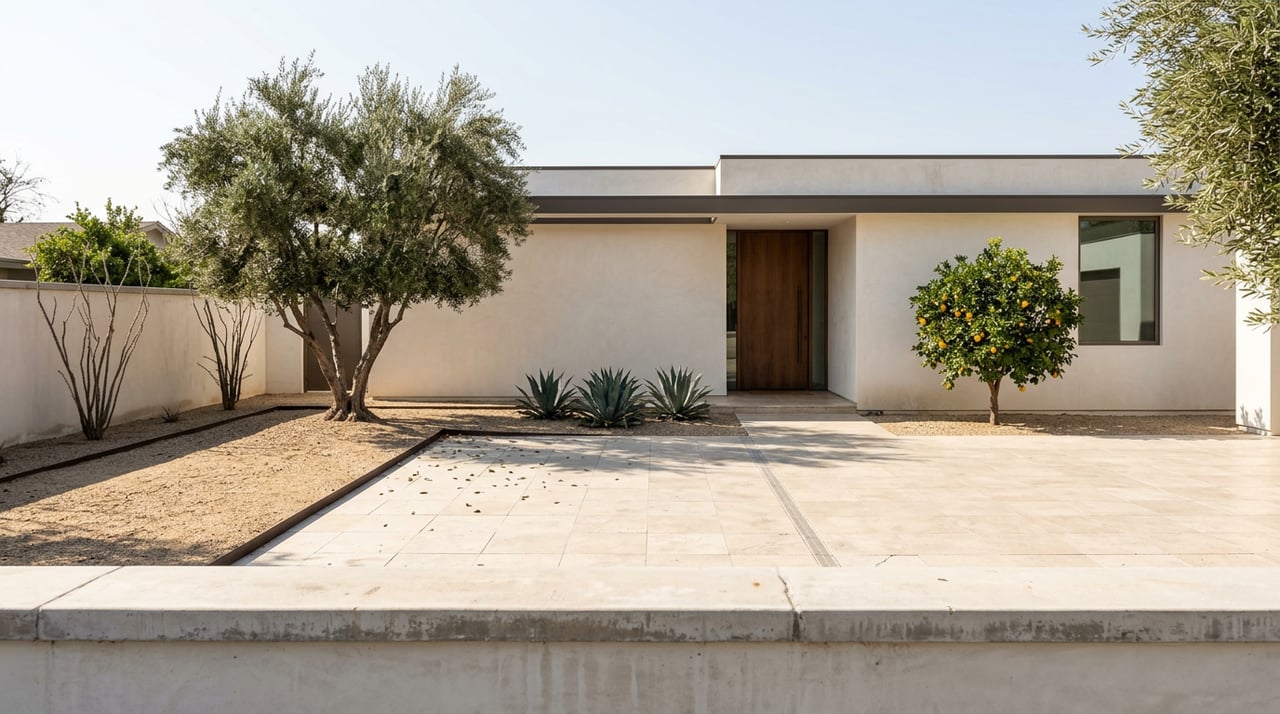
Two houses sit three doors apart on the same Arcadia block. Same zip code, same school pin, same distance to Camelback Mountain. One was gutted and rebuilt behind its original walls a couple of years ago. The other still has the kitchen it had decades ago and is being marketed almost entirely on what its lot could become. A buyer who prices either house off the neighborhood's median has no way of knowing which one they are actually looking at.
That is roughly what happens every time someone quotes "the Arcadia median" as though it points to one market.
As of June 2026 closings, the widely cited median sale price for Arcadia sat at $1,545,000, up 1.8 percent year over year, at an average of $618 per square foot across 79 transactions. Pull the number from a different source and it moves. Three months of closings ending in July 2026 put the median at $1.7 million with price per square foot at $563, up 8.5 percent year over year. A late-2025 snapshot from a different data provider showed $1.642 million and $606 a square foot. None of these sources is wrong. They are sampling different mixes of a market that is not actually one thing.
One Median, Four Products
Arcadia's current inventory breaks into four tiers that behave like four separate markets sharing a mailing address.
| Tier | Price Range | What It Actually Is |
|---|---|---|
| Original-condition entry | $920K to $1.35M | Largely unrenovated mid-century ranches, concentrated in Arcadia Lite toward the western edge of the neighborhood |
| Renovated core | $1.35M to $2.55M | Updated kitchens and baths on quarter-acre irrigated lots, the bulk of resale activity |
| Teardown rebuild | $2.55M to $4.55M | Custom new builds in transitional and warm-modern styles, priced primarily on land |
| Trophy estate | $4.55M to $9M+ | Large lots in Arcadia Proper with mountain views and pool or guest-house programs |
A buyer who anchors to the citywide median has no way of knowing which of these four products they are actually comparing against. Someone hoping to land a renovated three-bedroom for $1.5 million might be quietly outbid by teardown buyers who are willing to pay $2.5 million for a similar-looking house because they never intend to keep the house.
That last point is the one worth sitting with.
Why the Land Is Worth More Than the House
Arcadia's oldest housing stock sits on lots that were platted during the neighborhood's citrus-grove era, which means quarter-acre and larger parcels in a metro area where that lot size mostly stopped getting built decades ago. When a buyer values that scarcity more than the 1,400-square-foot ranch sitting on it, the math flips. The structure becomes the least valuable thing on the property rather than the asset being purchased.
The economics support that flip. Demolition on a standard Arizona house runs $8,000 to $25,000 in 2026 planning ranges, with the number driven mostly by square footage and how much debris a crew has to haul. A tight lot with close neighbors on both sides, which describes a lot of Arcadia, slows that work and pushes the estimate toward the higher end. Building back costs $200 to $350 per square foot for a standard semi-custom home and $350 to $600 or more per square foot at the luxury end. Add those numbers to a lot purchase and the total often still lands below what a buyer would pay to acquire a comparable finished home outright, while delivering a house built to current code on a lot size the market can no longer replicate.
That math is exactly why builders keep showing up. Thomas James Homes has a newly built five-bedroom listing in Arcadia. Cassa LA Studio recently completed a 6,188-square-foot estate with unobstructed Camelback Mountain views inside the Hopi school boundary in Arcadia Proper. Cullum Homes has current listings in the neighborhood as well, and the Patten family's Arcadia Custom Builders has been building in Arcadia long enough to describe it as a family tradition. Infill activity is not limited to the marquee streets either. A nearly 15,000-square-foot lot in the Arcadia Osborn pocket recently supported new construction sized at 4,659 square feet, the kind of lot-to-house ratio that only makes sense when the land is doing most of the pricing work. None of this is builders working in a vacuum. It is a response to a lot-value signal that the four-tier breakdown makes visible and a single median number hides completely.
The Appraisal Problem Nobody Mentions at the Open House
Here is where the tier structure stops being an interesting way to read a market report and starts being a transaction problem.
Standard purchase-money appraisals value the structure on the lot, pulling comparable sales of similarly aged, similarly sized homes. That works fine for a renovated-core buyer comparing one updated ranch to another. It breaks down for a teardown-tier buyer, because an appraiser working strictly off recent sales may pull comps from the original-condition tier for a house that is functionally being purchased as a vacant lot with a discount for demolition. The appraisal comes in low relative to the price the buyer actually agreed to pay, because the appraisal is measuring the house while the buyer is pricing the dirt.
That gap is a reasonable explanation for a pattern worth flagging. Cash purchases run roughly 34 percent of Arcadia transactions, well above the citywide Phoenix rate of about 18 percent. A buyer who is going to demolish the structure within months of closing has little use for a financing process built around valuing that structure, and cash sidesteps the appraisal mismatch entirely. If you are financing a purchase in Arcadia and you are not sure which tier your target house actually falls into, ask your lender how the appraiser plans to select comps before you are three weeks into escrow and staring at a shortfall.
Reading a Listing Like You Know Which Tier It's In
A few practical checks separate buyers who understand what they are bidding on from buyers who find out at appraisal.
- Pull the permit history on the property, not just the listing photos. A kitchen photographed in soft light can still be original 1970s cabinetry with a fresh coat of paint.
- Compare the lot square footage to the immediate block, not to the Arcadia average. A 15,000-square-foot lot next to a run of 8,000-square-foot parcels signals a different buyer pool than a lot that matches its neighbors.
- Ask directly whether the comps your agent or lender pulled came from the same tier as the subject property. A renovated-core comp applied to a teardown-tier offer, or the reverse, produces a number that means nothing.
- Watch days on market by tier rather than by neighborhood. Renovated homes under $2.5 million continue to attract multiple offers when priced correctly, while original-condition inventory tends to sit longer as buyers weigh remodel cost against rebuild cost.
Arcadia's broader numbers for 2026 show a market with more room to negotiate than it had a few years ago. Average days on market across all tiers ran around 74, active inventory grew roughly 17 percent over the prior 90 days, and homes have been closing around 95 percent of list price. That softening gives buyers real leverage, but only if they are negotiating against the right comparable set.
None of this means Arcadia's median is a useless number. It means treating it as a single price point, the way a buyer might treat the median in a subdivision full of identical floor plans, will cost you either the house you wanted or the negotiating position you should have had.
If you are trying to figure out which of Arcadia's four markets actually matches your budget and your plans for the property, that is a conversation worth having before you write an offer, not after an appraisal comes back confused about what it was supposed to be valuing. Heyman Luxury works these comps by tier, not by zip code average, for buyers and sellers across Arcadia and Paradise Valley. Schedule a Private Consultation to talk through where a specific property actually sits.
Frequently Asked Questions
Is Arcadia's teardown tier a good investment right now? Land scarcity in Arcadia is real and lot sizes here cannot be replicated elsewhere in central Phoenix. Whether a specific teardown purchase pencils out depends on demolition access, build costs at the time of construction, and how the finished home compares to trophy-tier sales nearby. Run the numbers on the specific lot rather than relying on neighborhood averages.
Why do Redfin, Realtor.com, and local market reports show different Arcadia medians? Each pulls from a different sample window and a different mix of the four tiers described above. A month with more teardown and trophy closings will push the median and price per square foot higher than a month dominated by original-condition and renovated-core sales.
Should I get a specialized appraisal if I'm buying a teardown-tier property? Talk to your lender early about how the appraisal will be scoped. Some lenders and appraisers have experience separating land value from structure value on intended-demolition purchases, and finding one before you are in escrow avoids a late-stage financing surprise.